
The Second Gaze
Sculptural Art as a Visual & Cognitive Sanctuary
BEYOND THE FIRST DEFINITION
What happens when we resist the first answer?
The mind is remarkably efficient at recognizing patterns, naming objects, and placing what it sees into familiar categories. Yet art can interrupt this quick certainty. A surface may appear geological yet unfamiliar; a form may resist immediate recognition; a material may seem to belong to more than one possible reality.
Research in empirical aesthetics suggests that ambiguity can play an important role in aesthetic experience. In studies of modern art, moderate levels of ambiguity have been associated with greater interest and appreciation, while perceptual moments of insight — when an initially unclear image begins to reveal a form — have also been linked to increases in aesthetic pleasure.
Perhaps uncertainty is not always something to eliminate.
Perhaps it can become a space in which perception stays active a little longer — searching, reorganizing, discovering.
What becomes visible when we stop asking the world to explain itself immediately?
CURIOSITY & THE UNKNOWN
What if uncertainty is not a space to escape, but a space to enter?
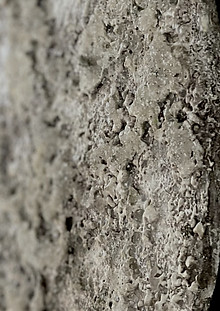
Curiosity has long been studied as more than simple interest. Neuroscience research shows that humans and other primates may actively seek novelty and information even when there is no immediate material reward. Uncertainty itself can create a drive to explore, ask, and discover.
Other studies suggest that states of heightened curiosity can also influence attention and memory. When people are deeply curious, information connected to that state may be remembered more effectively, and even incidental information encountered along the way can become more memorable.
Perhaps curiosity is more than the desire to know.
Perhaps it is what allows us to move toward what has not yet been defined — to remain open long enough for another possibility to appear.
What might exist within the deeper cavities of our inner world — the spaces that remain unseen until curiosity gives us the courage to enter them?
What could become possible if the unknown were approached with curiosity before resistance?
CRYSTALLIZATION — THE JOURNEY EMBODIED
Through pressure, matter keeps becoming—gathering clarity, opening into many facets, until light can move through it without taking away what it is.
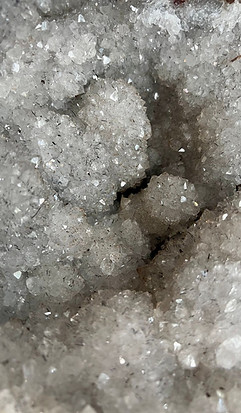
Crystals emerge through conditions that allow matter to reorganize into ordered structure. Their formation unfolds through processes of nucleation and growth, shaped by physical and chemical conditions such as temperature, concentration, fluid environment and, in many geological contexts, pressure and time. Different conditions can produce different structures, scales and forms.
This physical transformation opens another question:
Can change occur without the loss of what is essential?
In psychology, the concept of psychological flexibility describes the capacity to remain in contact with present experience while continuing to move in meaningful directions, even in the presence of uncertainty, discomfort or difficult emotion. Contemporary research increasingly treats this flexibility as a dynamic, context-sensitive capacity rather than a fixed trait.
Within Nour Khateb’s practice, crystallization becomes a language for this movement.
Pressure and purity are not simply opposite states. They can be understood as different faces of transformation. Purity is not the absence of disturbance, but the possibility of remaining connected to presence and value while form, circumstance and experience continue to change.
What if stability does not mean remaining unchanged?
What if it means discovering something within us that can remain present while everything around it transforms?
RECONSTRUCTING INNER FRAMEWORKS
What happens when what we encounter no longer fits what we already know?
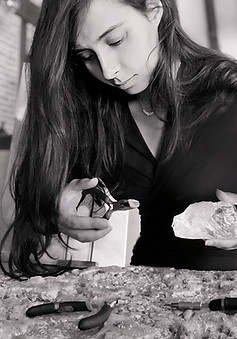
Perception is not a passive recording of the world. The brain continuously works through expectations, patterns and previous experience, adjusting its internal models when something no longer fits what it predicted. In contemporary cognitive science, this process is often discussed through predictive processing: perception unfolds through an ongoing exchange between expectation, sensory input and revision.
Research into aesthetic experience suggests that art can become a particularly rich space for this kind of restructuring. When an artwork disrupts an existing expectation, creates cognitive discrepancy, or resists immediate interpretation, the encounter may invite reflection, insight and the revision of previously held schemas. A 2024 systematic review of transformative aesthetic experiences identified cognitive discrepancy, insight and changes in existing frameworks among the recurring components described in such encounters.
Perhaps expansion does not always begin by adding more knowledge.
Perhaps it begins when the frame through which we understand something becomes too small.
What new possibilities appear when the mind is willing to rebuild the frame itself?
LIGHT WITHIN MATTER
What happens when light does not simply touch a surface, but enters it?
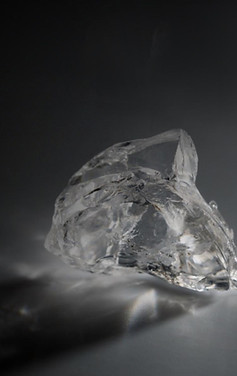
Translucency exists in a delicate territory between opacity and transparency. Light can travel beneath a material’s surface, where it is absorbed, scattered, transmitted and returned to the eye. Research in visual perception describes translucency not only as an optical property of matter, but also as a perceptual experience — one shaped by the relationship between material, illumination, form and the observer.
Our perception of a material is never produced by the material alone. The visual system continuously reads light, surface, shape and reflection together, constructing an impression of depth, density and substance from their interaction. Even the same material can appear differently as its scale, form or illumination changes.
Perhaps this is why translucent matter can feel as though it exists between states — solid, yet penetrable; present, yet carrying something beyond its surface.
In Nour Khateb’s work, light becomes more than illumination. It moves through the material, reveals hidden depths, fractures into multiple reflections and changes again with the position of the viewer.
If light can enter matter and reveal what the surface alone cannot show, what might another kind of light reveal within us?
And how much of what we call reality belongs to the object — and how much is completed in the act of seeing?
VASTNESS & AWE
What happens when an experience becomes larger than the frame we use to understand it?
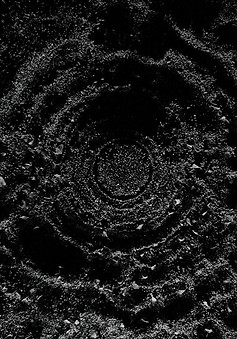
In psychology, awe is often described as an encounter with something perceived as vast — not only in physical scale, but also in complexity, time, meaning or conceptual depth. Such experiences can challenge existing mental frameworks and create a need to expand or reorganize the way we understand what is before us. A 2024 review in Nature Reviews Psychology describes awe as a multifaceted state that can shift perspective and move attention beyond an exclusively self-centered frame.
Vastness, then, does not always require monumentality.
It can appear in the depth of a geological surface, in the time held inside matter, in the precision of a crystal, or in the feeling that something contains more than can be grasped at once.
Perhaps awe begins at the moment our usual frame becomes too small.
Perhaps what feels vast is not always what stands far above us, but what opens a dimension we had not yet learned how to perceive.
What changes when we encounter something that cannot be reduced to a single scale, meaning or point of view?
And perhaps the second gaze is not about seeing more.
Perhaps it begins when we realize that what we see was never fixed in the first place.
Scientific Context & Research References